Three James Madison College students joined peers from universities across the United States and Canada this spring to discuss the future of relations between the two countries at a Virtual Student Summit hosted by Bridgewater State University.
Ethan Czaja, Anish Danappanavar and Grace Fitzgerald were among a dozen student participants in the online event, which included prepared remarks on assigned questions followed by open discussion.
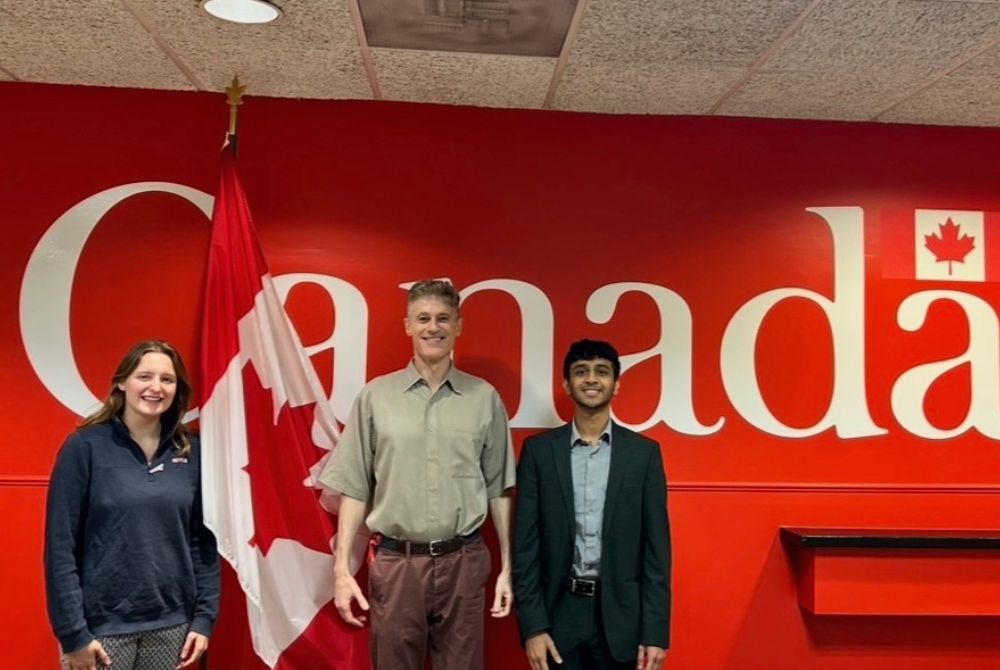
All three students are current or former interns with the Consulate General of Canada in Detroit through a partnership coordinated by MSU’s Canadian Studies Center (CSC), James Madison College and the consulate. The program began with two students in December 2024 and has since grown, with four JMC students beginning internships earlier this academic year.
The consulate connections led to their invitation to the Bridgewater State summit, where each was assigned a different discussion question.
Danappanavar, a senior majoring in International Relations and Political Theory & Constitutional Democracy with a third major in Economics, responded to a question about his personal and scholarly relationship with Canada. His experience immigrating to the United States from Canada as a child has shaped his interest in the bilateral relationship.
Czaja, a senior majoring in International Relations with minors in Russian and History, was asked what Americans should know more about Canada but don’t. He said he had assumed Canadian provinces functioned much like U.S. states, but learned through his work with the Canadian Studies Center and the consulate that the economic and cultural differences between them run deeper than expected.
.jpg)
Czaja first became interested in U.S.-Canada relations through his work as a CSC student assistant. That role led him to apply to the consulate internship, where he’s supported communications initiatives and worked on projects aligned with his academic interests, including a defense study on U.S.-Canada industrial technology collaboration in aerospace.
Fitzgerald, a senior majoring in International Relations, Economics and French, responded to what many participants considered the most provocative question of the day. She was asked whether the U.S.-Canada relationship can be repaired after Prime Minister Mark Carney told the World Economic Forum in January that the era of deepening economic integration between the two countries is over.
She drew on her consulate experience and academic research on automotive trade between the two countries (conducted as part of the college's two-part experiential learning structure) to frame her response around the sector’s deep interdependence.
“I think that within the automotive sector the rift can be repaired due to its historically integrated relationship,” Fitzgerald said, pointing to the upcoming renegotiation of the United States-Mexico-Canada Agreement (USMCA) as a critical moment for the relationship.
The summit question on the future of the relationship generated the most discussion among participants. Fitzgerald said most students, Canadian and American, believed the relationship could be repaired given the countries’ geographic proximity and economic interdependence, but that it would look different going forward.
“I think that most of the Canadian and American students alike believe the rift can be repaired because of our historical geopolitical ties, our large border connection and the considerable reliance we have on each other,” Fitzgerald said. “But we need to be honest. The relationship will not be the same.”
Both Czaja and Fitzgerald noted that the event underscored how differently citizens of each country experience the relationship. Canadian students described American culture and media as a constant presence in their lives, while American students acknowledged knowing less about Canada in comparison.
.jpg)
For both students, the consulate experience has shaped how they’re thinking about their futures. Czaja, who spent a semester at the Institute of Politics in Washington, D.C., last fall, is weighing graduate programs in Russian and Eurasian studies and national security as he considers careers in diplomacy or the intelligence community. His interest in Canada and his earlier focus on Russia and Eurasia have converged around Arctic policy, where U.S.-Canada collaboration intersects with competition involving Russia and China.
Fitzgerald entered the consulate expecting a straightforward introduction to international trade. Instead, she found herself working during a period of escalating tariff disputes and hearing directly from Canadian clients worried about their businesses and the border. The experience sparked an interest in immigration law.
The summit was one of several experiences that have given the students a closer view of U.S.-Canada relations than most undergraduates encounter. Danappanavar and Fitzgerald traveled to Indianapolis with Consul General Colin Bird during their internships for meetings with Eli Lilly executives and an Indiana exporters event focused on Canada-U.S.-Mexico trade. Czaja and Fitzgerald attended a Canadian National Railway Forum through the Canadian Studies Center and traveled to Ontario to visit Wilfrid Laurier University and the U.S. Consulate General in Toronto.
“There’s so much depth to that relationship that I didn’t realize was there,” Czaja said.
Related Story: Students gain diplomatic experience through internship partnership