Two hundred and fifty years after Adam Smith published Wealth of Nations, Brianne Wolf will spend the last week of June in Edinburgh, the city where Smith spent his final years and is buried. There, Wolf will speak to U.S. federal judges about the 18th-century economist and philosopher’s enduring influence on the American legal system.
An Inquiry into the Nature and Causes of the Wealth of Nations was published in March 1776, the same year as the Declaration of Independence, and Smith is widely regarded as a founding figure of modern economics. Wealth of Nations — Smith’s analysis of labor, trade and commerce — informed early American political thought and has shaped debates about markets and government ever since.
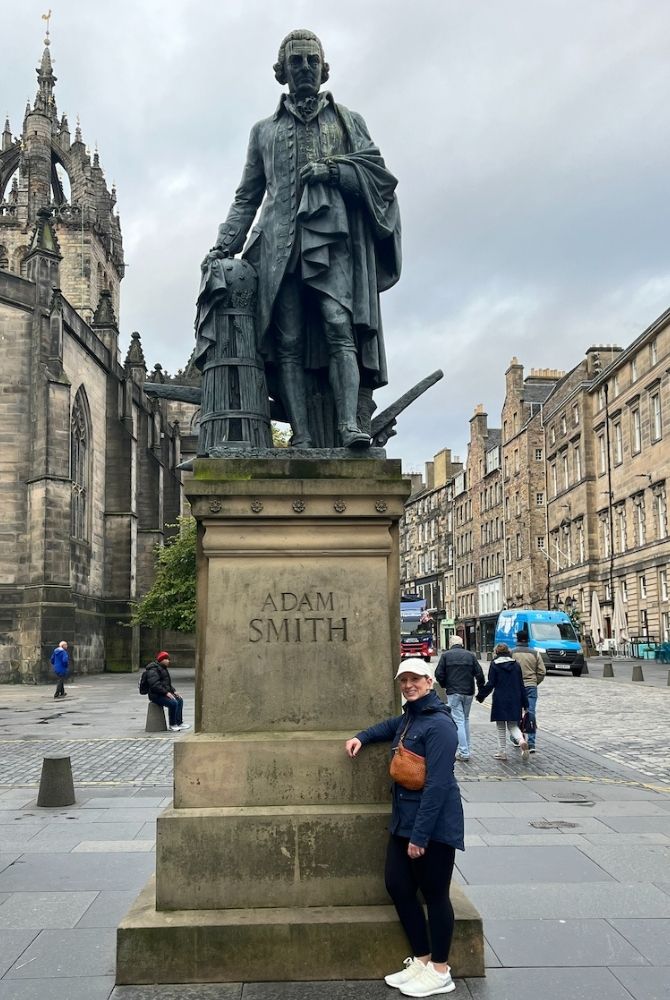
“There’s so much joy and excitement around this work that has proved relevant over these 250 years,” said Wolf, an associate professor of Political Theory & Constitutional Democracy at James Madison College. “People want the opportunity to disseminate its knowledge even more.”
The anniversary has generated renewed academic and public interest in Smith, and for Wolf, it brings a summer of lectures, travel and conversations about his work.
Alongside her trip to Edinburgh, Wolf will lead a colloquium for undergraduate students at Ohio University in June and a week-long deep dive into nearly everything Smith wrote with graduate students in Chicago in July.
The Edinburgh meeting, part of the Judge Douglas H. Ginsburg Judicial Colloquium Series, will bring together U.S. federal judges to study the lessons of Wealth of Nations 250 years later. Wolf will speak on what the text has to say about wealth and the American founding, and the case for reading Smith’s political economy as moral philosophy.
She is also hoping to draw on a lesser-known strand of Smith’s late work. At the end of his life, Smith had several unpublished books underway, including one on jurisprudence. Though the manuscript was lost, scholars still have student lecture notes from Smith’s teaching. Wolf said those notes — which explore questions of law, justice and political order — may offer insights relevant to the federal judges attending the colloquium.
The Ohio University meeting is aimed at students encountering Smith for the first time. Wolf is collaborating with economist Cortney Rodet, whose students — like most undergraduates — rarely have the opportunity to read Smith in depth. At JMC, students typically only meet Smith in excerpts and passing discussions, with close reading reserved for Wolf’s senior seminar.
The Ohio colloquium will connect a small group of JMC and Ohio U students for two days of discussion-driven reading, with Wolf and Rodet connecting Smith’s ideas to current economic questions.
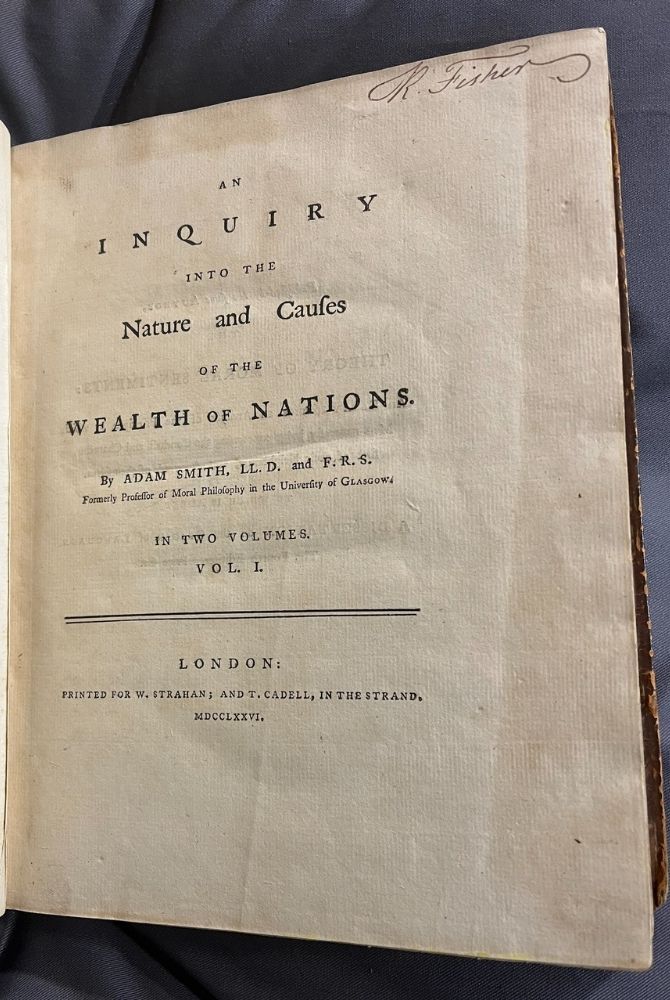
Sp Coll q623-624, With permission of University of Glasgow Archives & Special Collections.
Addy Meyers, a rising JMC senior who participated in the colloquium last summer and will return this year, said some of the most valuable conversations came from the students around the table. With participants from economics, political science and JMC, she said, the discussions brought together a wide range of perspectives while continually connecting Smith’s theories to contemporary issues. “I’m looking forward to learning more and thinking about economic theory in new ways again this year,” Meyers said.
During the Liberty and Responsibility in Adam Smith event in Chicago (known among scholars as “Smith camp”), Wolf will spend a week with graduate students exploring nearly all of Smith’s published works, with participants drawn from political theory, economics, philosophy, public policy, history and anthropology.
“I’m really excited about the way they’re going to turn the text inside out for me,” Wolf explained. “They’ll take me to some page that I’ve not paid any attention to, and that will change my thinking.”
In all three settings, Wolf’s approach is the same: she uses Smith to help ease people into discussions of economics.
“Economics can feel really intimidating for people,” she said. “That’s surprising, because in American politics, one of the old adages is that ‘as the economy goes, so go elections.’ People are very interested in their everyday experience of the economy. But when we move to the formal science of economics, they feel so intimidated.” Smith, she has found, makes a useful entry point. “He tells a lot of stories, a lot of character vignettes. It’s actually surprisingly accessible.”
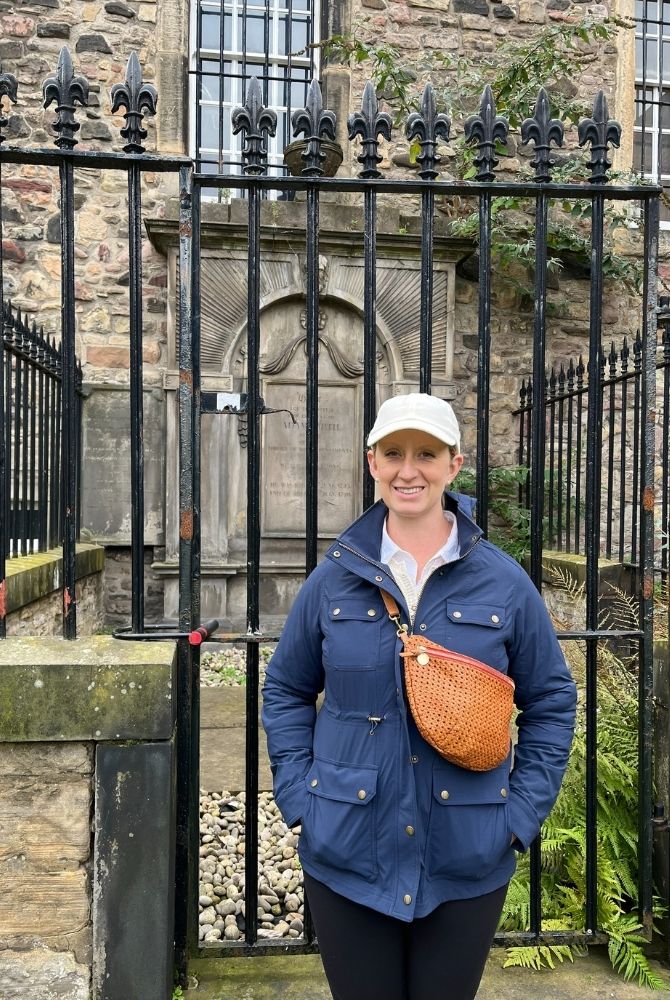
The summer will also bring Wolf back to the University of Edinburgh’s Smith archive, which she last visited in the fall of 2023. The trip left Wolf with a long list of materials she hopes to explore: marginalia in his copies of writings on aesthetics, his copies of Rousseau and a closer look at his commentary on America. “I’m looking to see if he made margin notes in them,” she said, “or if parts of those works were important to him that we wouldn’t have access to otherwise.”
Wolf has worked on Smith for much of her career. Her current book project, tentatively titled Beyond Rights and Price: Liberalism with Taste, argues that liberal democracy depends on moral and emotional habits that are often overlooked. For Wolf, questions of “taste” are tied to democratic practice itself. Forming and defending an opinion about something as ordinary as wine, as an example, calls for skills that democratic life also demands: making a judgment, offering evidence and arguing it out with people who disagree.
Smith is one of four thinkers at the center of Wolf’s argument, alongside David Hume, Jean-Jacques Rousseau and Alexis de Tocqueville.
Wolf will also teach Smith during this summer’s inaugural cohorts of the James Madison College Academy for Civic Education. This new federally grant-funded program invites Michigan high school students and teachers into primary-source seminars that explore the nation’s founding principles in coordination with the 250th anniversary of the Declaration of Independence. Wolf said economics is a subject that Michigan teachers are expected to cover, but one many find challenging to teach. Smith offers an entry point, she said, alongside the political debates shaped by his economic ideas.
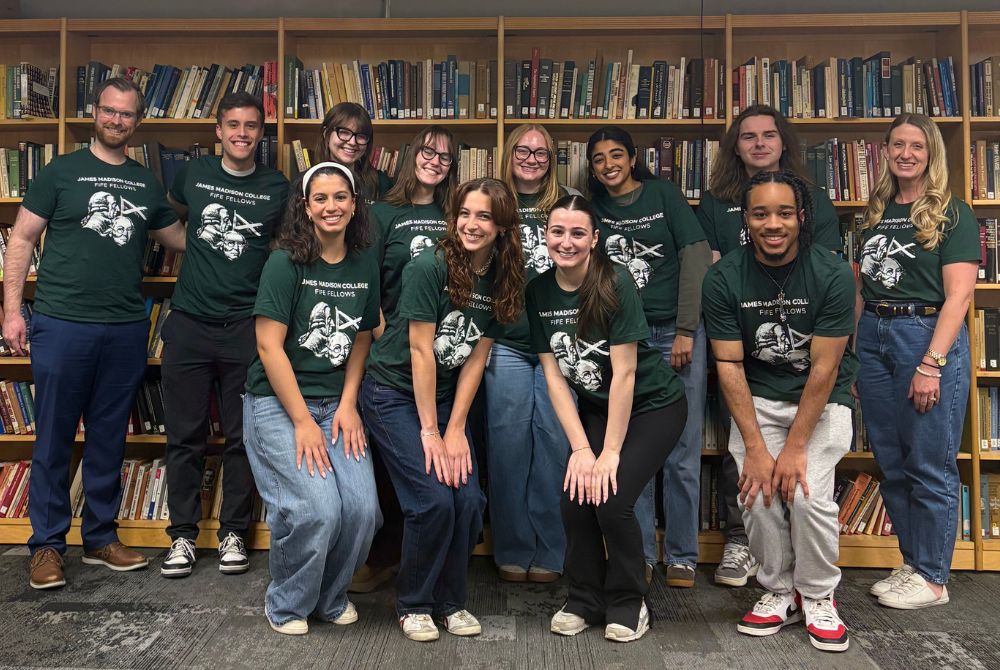
That broader engagement is part of what draws students to programs like the Adam Smith colloquium and JMC's Fife Fellow Program, which explores ideas central to contemporary liberal democracy. Bella Cucchetti, a JMC student in both programs, said studying Smith and other major thinkers helps her make sense of contemporary political and economic challenges. “I don't want to give up and resign to the idea that ‘our country is just broken,’” she said. “I want to understand why and how these things went wrong, and figure out how to fix it.”
Even outside the classroom, Wolf finds Smith turning up in contemporary debates. She recently pitched an op-ed after rereading a Smith passage on needlework, a subject she knows firsthand as a needlepointer. After a pandemic boom, the industry is now feeling the strain of tariffs on imported supplies, including canvases, threads and frames that are produced overseas. Stores are responding with printed canvases and new thread lines, demonstrating the kind of innovation pressure Smith recognized in his time.
“One of the things I enjoy about being a Smith scholar is there are a lot of enduring questions that I can bring to bear 18th century insights to 21st-century problems,” she explained.
Related Story: Ask the expert: Adam Smith’s writings help us understand our modern economy (MSUToday)