When the U.S. government imposed a curfew on Japanese Americans after the bombing of Pearl Harbor, conventional historical narratives say there was little resistance. Through her research, JMC Prof. Anna Pegler-Gordon found the voices of those who resisted in FBI case files.
While working on a separate project at the National Archives, Pegler-Gordon discovered a trove of files documenting the experiences of people who had been picked up for violating the curfew. The files included detailed interviews, and the voices within them belonged overwhelmingly to young people.
“Historians have literally said the curfew wasn’t that important,” explained Pegler-Gordon. “And then I’m looking at high schoolers and college students who really, understandably, say the curfew was terrible: ‘This was what really upset us.’ ‘This was what we had to fight.’”
This research is part of Pegler-Gordon’s broader scholarship on Asian American experiences with U.S. immigration and citizenship policy. Recently named Director of Asian Pacific American Studies at MSU, she has taught courses in these areas at both JMC and the Department of History since arriving at MSU in 2002. She’s been part of the APA Studies program since it was founded in 2004, including a previous period as its director.
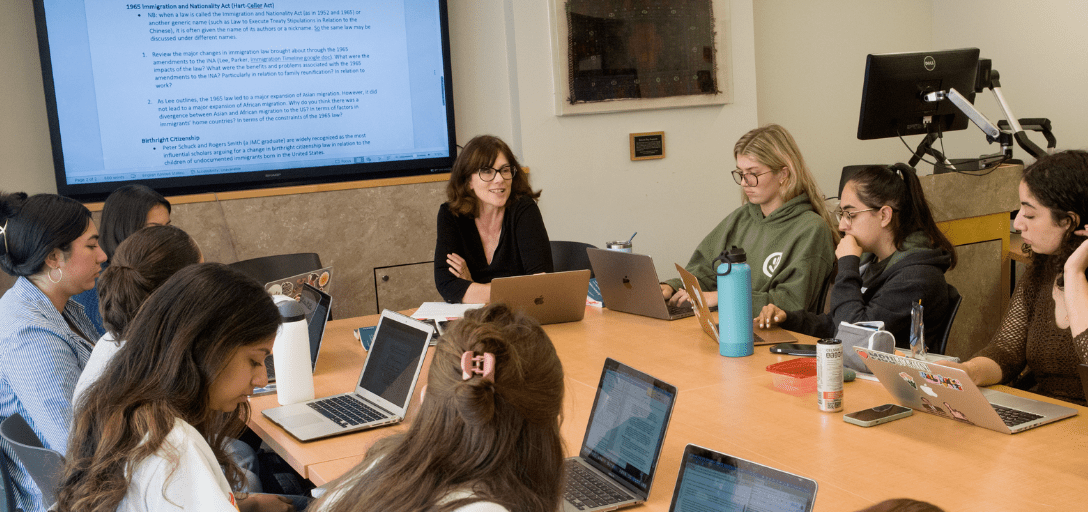
“It’s really felt like I’ve had these two intellectual homes,” said Pegler-Gordon. “James Madison College is the place where I think about my work as it relates to immigration policy and citizenship policy. And then I have this other side, which is focused on the Asian American side of things, which is the core of my research.”
Pegler-Gordon’s current research pursues two threads: one exploring curfew resistance during World War II, the other examining the 19th-century Supreme Court case on birthright citizenship.
After the attack on Pearl Harbor in December 1941, Japanese nationals and Japanese Americans on the west coast were placed under curfew and contraband restrictions months before they were forced into concentration camps. Historians have given this period little attention, but Pegler-Gordon argues it was a critical time of resistance.
Few of the young people in the FBI files cited their American citizenship as the basis for defiance. Instead, they simply insisted on their right to live their lives — going to the movies or staying out with friends — refusing to accept the restrictions as legitimate.
“A detective would stop a Japanese American outside of a movie theater and say, ‘Do you realize it’s the curfew? Why are you out late?’” she explained. “And they would say, ‘Because this film doesn’t finish until 9 p.m.’”
Pegler-Gordon attributes the historical blind spot to several factors: scholars have tended to focus on formal politics, community organizations and adult leaders rather than on young people. And because the young people were trying not to get caught, the resistance was designed to be invisible.
Through her research, she’s discovered that this pattern extended well beyond the west coast. Across Utah, Idaho, Colorado and other states, Japanese Americans who weren’t forced into camps still lived under curfew restrictions for much of the war.
Pegler-Gordon’s second research thread examines the legacy of United States v. Wong Kim Ark, the 1898 Supreme Court case that established birthright citizenship for all people born on U.S. soil. Wong Kim Ark, born in San Francisco to parents who were Chinese immigrants, was denied re-entry to the United States after a trip to China. The government argued that because he was ethnically Chinese, the 14th Amendment’s guarantee of birthright citizenship did not apply to him. The Court disagreed. That ruling has become the subject of renewed political and legal scrutiny under the Trump administration, which has sought to end automatic birthright citizenship.
Pegler-Gordon is among five historians who co-authored “The Historical Paths to and from Wong Kim Ark,” a forum published in Modern American History that examines legal and ideological battles over birthright citizenship from the late 19th century into the early 20th. She also contributed an essay to the forum that explores how documentation of birthright citizenship was used to both verify and undermine Chinese Americans’ claims to U.S. citizenship.
Several arguments now being advanced to limit birthright citizenship, Pegler-Gordon says, don’t hold up against the historical record. Critics claim the 1898 court never considered unauthorized immigration, but she points out that widespread unauthorized entry among Chinese immigrants was well known at the time and was part of the context in which the case was decided. The court also weighed whether the loyalty of non-citizen parents should affect their children’s citizenship and still affirmed the principle.
“One thing that they say is that the court didn’t know about illegal immigration back in 1898,” she said. “That’s not true. They widely knew that Chinese immigrants were unauthorized. That was partly why they went after Wong Kim Ark.”
As director, Pegler-Gordon sees Asian Pacific American Studies as a central gathering point for scholars and community members doing related work across the university and the state. Among her priorities is expanding enrollment in the program’s minor and its course offerings so that more students can study the experiences of Asian Americans in depth. She also plans to support undergraduate and graduate research across the university, building on the program’s role as a home for scholars working in different departments and disciplines.
That community-building work is visible in the program’s annual symposium, scheduled for March, which draws faculty, students and activists from institutions around Michigan. The event’s keynote speakers will include JMC graduate Emily Nguyen (CCP ’18), Policy & Political Director with Rising Voices.
“It feels like it’s all very full circle,” she said, “that I’m teaching students history and policy and then they go off and actually do the work of history and policy and then they come back and talk to our students.”