When Christopher Conner began exploring the Stephen O. Murray archives at MSU Libraries, the experience was unexpectedly personal. Notes between Murray and his contemporaries. Records of conflicts over queer visibility on campus, including an effort to bring a drag show to Michigan State that was met with resistance. Political moments from the 1980s and ’90s — the March on Washington, the upheaval of his own youth — that he hadn’t thought about in years.
“It was like time travel,” Conner said.
That experience shaped the direction of this year’s Stephen O. Murray Symposium, which Conner is organizing as the 2025-26 Murray Scholar in Residence. The event, titled “Queer Futurisms: Identity, Culture and Critique,” will take place at James Madison College on April 15.
Murray, a sociologist, anthropologist and comparative historian, was part of JMC’s second graduating class in 1972. Murray published extensively on sexual and gender diversity, sociolinguistics and the history of the social sciences, including field-defining works American Gay and Homosexualities.
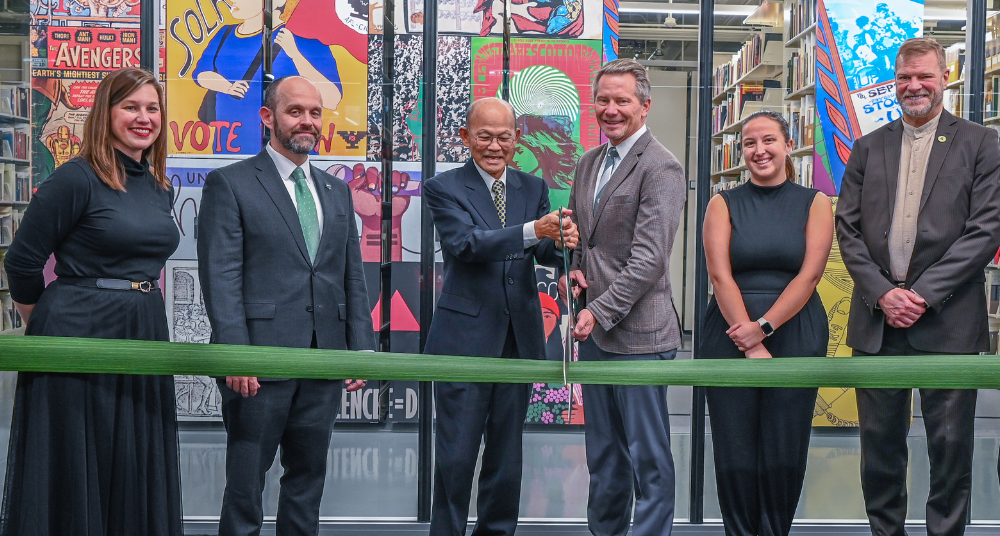
In 2019, Murray’s partner, Keelung Hong, donated his personal papers and research materials to the MSU Libraries, along with a financial gift that funded the renovation of the libraries’ Special Collections space, which now bears both their names. The collection serves as the foundation for the JMC scholar in residence program that brought Conner to campus.
The April 15 symposium is structured around two sessions. The morning session, “Friendship, Community, Pride and Critique,” brings together scholars whose work examines LGBTQ+ spaces, relationships and history through qualitative and ethnographic methods. Their work explores how queer communities have formed and changed, and how race, class and gentrification have shaped them.
The afternoon session, “Identity, Belonging and the Future,” shifts toward personal narrative and forward-looking scholarship. Presentations explore queer joy and community, the role of TikTok creators in producing pro-LGBTQ+ content that disrupts conservative online spaces, and frameworks for conceptualizing the future of sociological research on sex, gender and sexuality.
Conner’s own contribution bridges the academic and the personal. His paper, a spoken-word autoethnography, traces drag’s centrality to LGBTQ+ culture through the decades of his own life. Conner will share his time with Tajma Stetson, a drag artist who got her start performing in Lansing.
Stetson will close the symposium with “What Makes a Man a Man,” which Conner describes as one of the most spectacular performances he has ever seen. The piece, based on a song by French artist Charles Aznavour, tells the story of a performer who begins in full drag and slowly transforms, using the act of undressing as a meditation on gender and what it means to live authentically.
The decision to incorporate drag into the symposium is both scholarly and historical. Conner’s archival research uncovered records of earlier efforts to bring drag performance to MSU that were met with institutional resistance. His paper examines how drag has served as a site of community and resistance, which are themes that connect directly to Murray’s own scholarship on sexual and gender minorities.
The symposium presenters are connected not just through scholarship but through personal relationships that Conner describes as central to the work. Many collaborated on his edited volume The Gayborhood: From Sexual Liberation to Cosmopolitan Spectacle, and several have close ties to Murray’s legacy. C. Winter Han, who corresponded with Murray and serves as co-editor of the forthcoming volume from the symposium, is one example. Salvador Vidal-Ortiz, the inaugural Murray Scholar, is another.
“These are not just people whose work I admire,” Conner said. “These are friends of mine, and that’s super important in a field that can sometimes feel isolating.”
Papers from the symposium will be published in a volume co-edited by Conner and Han, each connecting Murray’s work to present-day concerns.
The 2026 Stephen O. Murray Symposium will be held on April 15 at James Madison College in Case Hall (Zoom option available). The event is free and open to the public. Registration is available via Eventbrite.
Event Lineup
Session 1: Friendship, Community, Pride, and Critique
9:45 to 11:45 a.m.
Presider: Christopher T. Conner
- “Bonding in Murray’s Gay Male Friendships,” Presented by Salvador Vidal-Ortiz, Professor of Sociology, University of Connecticut
- “Race, Racism and the Future of Gay Pride,” Presented by C. Winter Han, Professor of Sociology, Middlebury College
- “After the Gayborhood: Stephen O. Murray and the Problem of Gay Urban Space,” Presented by Theo Greene, Associate Professor and Chair of Sociology, Bowdoin College
- “Gay Places, Queer Futures,” Presented by Greggor Mattson, Professor of Sociology, Oberlin College
Session 2: Identity, Belonging, and the Future
3:30 to 5:45 p.m.
Presider: C. Winter Han
- “‘We Will Win’: What I Learned by Reading The Faggots and Their Friends Between Revolutions, with a Queer Reading Group,” Presented by Vanessa Panfil, Associate Professor of Sociology and Criminal Justice, Old Dominion University
- “Library Joy and Digital Literary Activism on #BookTok and Beyond,” Presented by Anthony Boynton, University of Kansas
- “Queer Foretold: Sociological Futurology and Sexual Futurities,” Presented by Desmond Francis Goss, Assistant Professor of Sociology, George Washington University
- “By the Grace of Drag Queens Go I,” Presented by Christopher T. Conner, Assistant Professor of Sociology, University of Missouri-Columbia
- “What Makes a Man a Man” (performance), Presented by Tajma Stetson, Drag Artist and Professional Clarinetist