In graduate school, Chris Conner wanted to study LGBT community in Las Vegas and explore how sexuality is performed in a city shaped by tourism. At the time, some faculty questioned whether community could exist in a bar, what Conner describes as “a very straight way of looking at the world.”
“Many of the people I know throughout my life met their partners at a gay bar,” Conner explained.
That early experience helped shape Conner’s trajectory as a scholar. As he saw ways that LGBTQ+ scholarship faced stigmatization, opportunities to focus on that area of his research became increasingly meaningful.
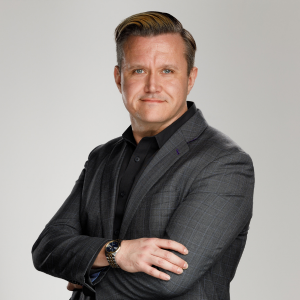
James Madison College has named Conner as the 2025-26 Stephen O. Murray Scholar in Residence. Conner, an assistant professor of sociology at the University of Missouri-Columbia, brings expertise in criminology, social movements, technology, gender and sexuality, with a focus on how large-scale technological shifts transform human interaction.
The scholar in residence program honors the legacy of JMC alumnus Stephen Murray (’72), who passed away in 2019. His longtime partner, Keelung Hong, donated Stephen’s life works to the MSU Libraries Special Collections and a $5 million gift in his name. The program encourages LGBTQ+ scholarship by providing academics access to the over 500,000 printed works in the Stephen O. Murray and Keelung Hong Special Collections and by supporting engagement with the university community.
“This opportunity lets me focus on LGBTQ scholarship, especially at a time where things are so political and so hyperpolarized,” Conner explained. “There’s a real need for people to be able to pursue scholarship in a lot of different areas, including this, especially at a particular moment in history where LGBTQ rights are being called into question.”
Studying online platforms, community and cybercrime
Conner’s current research examines a troubling paradox: how online platforms designed to connect LGBTQ+ people are increasingly being exploited to target and harm them. His work on cybercrime explores multiple forms of digital violence, from physical assaults facilitated through dating apps to sophisticated fraud schemes. Young people use apps to lure targets for assault, sometimes filming the attacks to gain social media clout. Sextortion schemes threaten to expose intimate photos unless victims pay money. Closeted individuals face additional vulnerability, as the fear of being outed can prevent them from reporting crimes to authorities.The scope of the problem is significant. According to the FBI Internet Crime Complaint Center, deception scams — including romance fraud and sextortion — defrauded U.S. victims of $16.6 billion in 2024, a 33% increase from 2023.
Conner’s research has also documented instances of law enforcement agencies themselves sometimes using these platforms in ways that mirror criminal tactics, raising questions about surveillance and entrapment. “Since June, 200 men have been arrested in New York City,” Conner said, referring to arrests at a Penn Station bathroom targeted by Amtrak police using an online hookup app. At least 20 of those arrested were taken into ICE custody.
Studying this phenomenon has proven challenging. Conner and a small team of volunteer undergraduate research assistants have been issuing Freedom of Information Act requests to law enforcement agencies across the country, receiving widely varying responses. Some have provided data, while others have declined to cooperate or required thousands of dollars to release information. Without consistent cooperation, the team has relied on media reports and interviews with attorneys to document patterns of app-facilitated violence and exploitation.
Without access to comprehensive official data, Conner hopes to conduct a national survey of LGBTQ+ people about their experiences with cybercrime and technology-enabled harm—however, securing funding for his work has proven difficult.
Looking to history
Conner’s approach to understanding the present moment is deeply informed by the past, aligning closely with Stephen O. Murray’s own scholarship. A sociologist, anthropologist and independent scholar who was part of JMC’s second graduating class in 1972, Murray published extensively on sexual and gender minorities, producing seminal works including “American Gay” and “Homosexualities.” He was a founding member of the Sociologists’ Gay Caucus and helped establish what is now called the Association for Queer Anthropology.
In “American Gay,” Murray called for sustained examination of the history of the gay rights movement. Conner sees his work as helping to fulfill that call by using Murray’s scholarship as a springboard to the present. Conner is also informed by the same intellectual tradition that Murray was trained in drawing on the work of the Frankfurt School.
Throughout the academic year, Conner will host a series of events for the MSU community. He plans to deliver lectures in November and March, exploring topics including how apps have transformed LGBTQ+ community life and the historical evolution of gay rights activism. His work also examines what he describes as a potential fourth wave of gay rights activism, as threats to trans rights, marriage equality and other civil rights gains mobilize a new generation.
On April 15, Conner will also host a “Queer Futurisms” symposium that will feature ten scholars, including Dr. Philip Pettis, assistant professor of sociology at MSU, presenting on topics central to LGBTQ+ communities, from contemporary challenges to historical perspectives, with each scholar addressing both current issues and pathways forward. Conner’s contribution will explore drag and its centrality to LGBTQ+ culture. The symposium will close with a drag performance by a performer who began their career in East Lansing, Tajma Stetson.
The event will result in an edited volume that serves as a homage to Murray’s legacy, with each chapter referencing Murray’s work and connecting it to present concerns.
Conner looks forward most to working with students during his time on MSU campus. While much of Conner’s research examines challenging topics within cybercrime, he emphasizes the importance of balancing that work with a focus on joy. This approach will inform his engagement with the MSU community throughout the year.
He also hopes to show students that they can pursue academic careers while being unapologetically themselves.
“I am most looking forward to meeting the wonderful students there at Michigan State and hopefully being an inspiration for what they can accomplish,” he said. “There are really only a handful of out, gay and queer and non-binary and trans and intersex individuals within academia. We’re a very small group. With the caveat that they might not always fit in… But there is a reward for this kind of work.”
Conner’s work has appeared in Critical Sociology, The Sociological Quarterly, Deviant Behavior, Symbolic Interaction and Sexualities. He contributes regularly to Salon and The Conversation. He received the 2023 Kathy Charmaz Early in Career Award from the Society for the Study of Symbolic Interaction. His next book "The Spectacle of Online Life" will be out this Halloween, his last book “Conspiracy Theories and Extremism in New Times” received a Choice Books Recommendation.
Dr. Conner’s first scholar in residence event, "Policing Desire: How Digital Surveillance Turns Queer Intimacy into a Crime," will be held on Nov. 5 in Club Spartan (338 Case Hall). Time TBA.