A global team of researchers has developed a comprehensive framework to close gender data gaps in small-scale fisheries, addressing the persistent undercounting of women’s contributions to the sector.
The perspective paper, published in September 2025 in the journal Ambio, brings together insights from 36 contributors across six continents — including Michigan State University Profs. Mar Mancha-Cisneros and Mark Axelrod — to propose concrete solutions that address these gaps.
Small-scale fisheries provide livelihoods to approximately 500 million people globally. Recent research estimates that women comprise 39.6% of the small-scale fisheries workforce — more than double what traditional data systems suggest — yet gender data gaps persist throughout national and international fisheries systems.
“Nobody’s mandate is to understand the whole system,” said Axelrod, professor at MSU’s James Madison College and Department of Fisheries and Wildlife. “Fisheries agencies manage fish stocks. Health ministries track disease. The siloed nature of government agencies creates challenges for comprehensive data collection and analysis.”
These data gaps have wide-ranging consequences. Incomplete fisheries data undermines ecological conservation, limits economic forecasting and makes it impossible to measure whether gender equity initiatives are working — affecting outcomes from biodiversity protection to poverty alleviation.
Building on Illuminating Hidden Harvests
“Designing gender-inclusive data systems in small-scale fisheries” emerged from the Illuminating Hidden Harvests (IHH) initiative, a multi-year study by the UN Food and Agriculture Organization (FAO), Duke University and WorldFish that examined small-scale fisheries across 58 countries. Dr. Sarah Harper, now community-based fishery lead at Coastal First Nations - Great Bear Initiative, was invited to co-lead the gender analysis for IHH in 2018. That analysis, originally planned as a single chapter, soon expanded into a larger collaborative effort.
Harper and co-lead Danika Kleiber, a social scientist for NOAA Fisheries Pacific Islands Fisheries Science Center, organized a special session at the 2022 Gender in Aquaculture and Fisheries Congress. They invited experts from around the world to address a fundamental question: What does a gender-inclusive data system actually look like, and how do we get there?
“Through the Illuminating Hidden Harvests process, we saw that even with significant capacity and effort, there were huge barriers to finding gender-disaggregated data,” Harper said. “It wasn’t for a lack of trying. We saw certain patterns in where these limitations were and how they impacted things.”
“When we started writing, it was so easy to fall into identifying problems,” Harper added. “But we wanted to really focus on the path forward and what that better place looks like.”
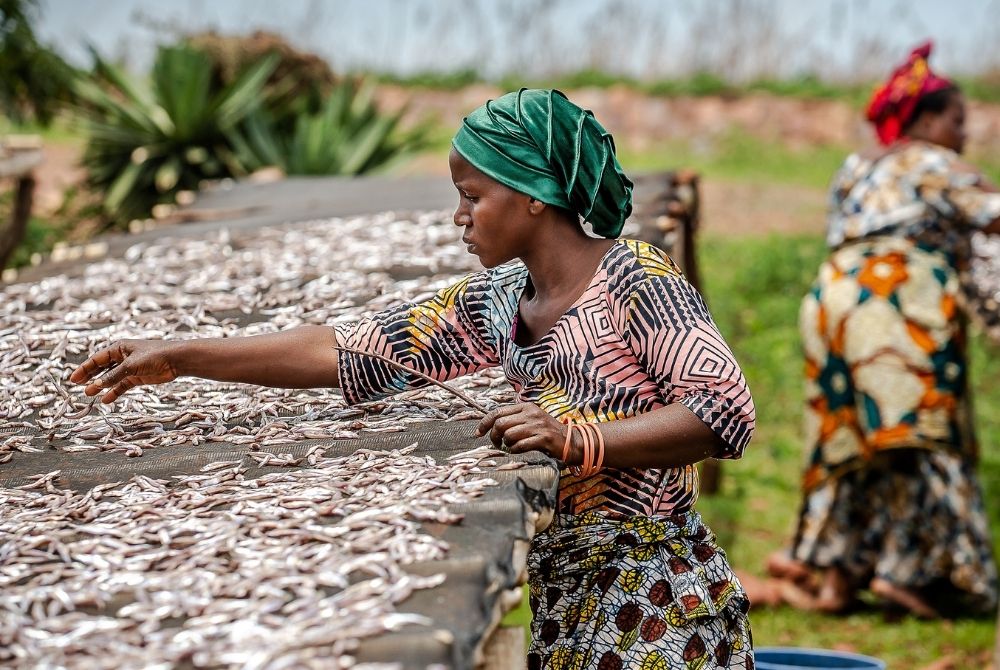
The IHH study revealed the scope of women’s participation across different parts of the small-scale fisheries sector: women represent 45% of people engaged in subsistence fishing activities globally and comprise nearly half of workers in fish processing (48.7%) and trading (50.2%). However, in commercial fishing operations — where data collection efforts have traditionally focused — women make up only 18.7% of workers.
These gender data gaps are both structural and persistent. National and international fisheries agencies typically focus on commercial vessel-based fishing, which is predominantly male, while overlooking subsistence fishing, informal work and processing activities where women’s participation is often higher. Additionally, data on household and reproductive labor, that support fishing operations, is seldom collected.
A Gender-Inclusive Framework
To capture gender-inclusive data, the framework identifies specific needs organized into three thematic areas:
- Economy and Environment includes nine indicators covering labor force participation across formal, informal and subsistence sectors; resource access entitlements; technology ownership; financial services access; and education and skills.
- Governance and Support Services includes three indicators measuring participation and leadership in resource governance bodies, policy provisions and access to support organizations and services.
- Health and Nutrition includes five indicators gauging physical and mental health, occupational hazards and injuries, nutritional status and access to healthcare.
The interdisciplinary team behind the perspective paper mapped out which agencies would be responsible for collecting each type of data and their analysis revealed a critical insight: comprehensive gender data cannot come from fisheries agencies alone. Approximately 60% of the 17 proposed indicators require data from agencies outside traditional fisheries management, including national statistical offices, health ministries and economic development departments.
The paper includes detailed mapping of which government agencies should collect which indicators and where that data should be stored, making implementation more concrete.
.jpg)
Steps Forward
Rather than requiring entirely new data collection efforts, the framework emphasizes building on existing infrastructure.
“I think there’s a lot that can be done with data that are already being collected,” Harper said. “Having some sort of mapping exercise of what data already exists, not maybe within one agency, but across other agencies, and looking for how you can build connectivity and collaboration.”
Harper outlined a three-layer approach to implementation. First, identify and make existing data accessible and usable across agencies. Second, adjust existing data collection systems with modifications such as adding fisheries-specific questions to household surveys or ensuring survey instruments capture informal and subsistence work. Third, initiate new data collection only where gaps truly exist.
National labor force surveys, household income and expenditure surveys, and population censuses already collect data. The researchers recommend that fisheries experts work with statistical offices to ensure these surveys identify fisheries households and capture the full range of fisheries activities.
The paper addresses how to build support for gender-inclusive data within institutions with different objectives, recognizing that agencies will need different rationales based on their mandates.
For agencies with ecological mandates, gender-inclusive data on resource use reveals total human pressure on ecosystems. Overlooking women’s harvesting means underestimating total catch and the impacts of particular fishing methods, which can undermine the effectiveness of conservation measures. For groups with economic development goals, complete labor force data enables more accurate macroeconomic forecasting. For agencies with social equity mandates, baseline gender data makes it possible to measure progress toward equality goals and evaluate intervention impacts.
“We’re cognizant that there’s a very economic focus to the current moment, so being able to show clear measurable results is essential for any initiative,” Harper said. “As much as we approach this work from a gender equity and justice lens, we also recognize the need to demonstrate clear outcomes.”
.jpg)
Coordinating Across Continents
The paper represents a unique level of international collaboration across disciplines. Harper and Kleiber initially reached out to researchers around the globe who had influenced their work. The resulting team of 36 co-authors spans six continents and includes researchers and practitioners from Nigeria, Japan, India, Mexico, Sweden, Fiji, Tanzania, Canada and beyond. The group brings expertise from fisheries biology, political economy, anthropology, environmental science and direct work with fishing communities.
The diverse perspectives proved essential. “It really added a certain depth to the paper - drawing in a rich set of perspectives from communities around the world,” Harper said. “As I was writing, I was often relating it in my head to my own experience working with Indigenous Nations and the Canadian Fisheries Agency, and also thinking about how different that context might be compared to colleagues in Malawi or somewhere else.”
The group coordinated across time zones using virtual tools, and broke into smaller working groups for specific sections. Harper credits the collaborative spirit and flexible timeline with keeping all contributors engaged over several years.
Dr. Meryl Williams, who has been a trailblazer in promoting gender equality in fisheries and aquaculture economics, establishing gender sections within organizations like the Asian Fisheries Society, provided crucial guidance. “She contributed insights from her many decades of working in this area,” Harper noted. “I’m so grateful to have had the chance to work alongside her and learn from her continued dedication to this field.”
The paper is part of a larger collection published across Nature journals related to the IHH initiative. Funding for publishing this piece as open-access was provided by the Stanford Department of Environmental Social Science (Doerr School of Sustainability), making the framework more accessible to practitioners and policy-makers.
The framework is designed to be adapted to different contexts and resource constraints. Harper emphasized that agencies should begin by mapping existing data sources and building collaborations before undertaking new collection efforts to make implementation more feasible with limited resources.
“Designing gender-inclusive data systems in small-scale fisheries” and supplementary materials, including detailed indicator specifications and data source mapping, are available at https://doi.org/10.1007/s13280-025-02250-5.