Early into his time in Ireland, Colin Reese stood waist deep in a tide pool, pulling invasive seaweed from rock formations along Dublin’s south coast. The work was part of his internship, but it was also the start of something bigger: a summer that would help shape his understanding of environmental governance and earn him recognition as a finalist for The Forum on Education Abroad’s Award for Academic Achievement Abroad.
The award celebrates undergraduate students who demonstrate exceptional academic work during education abroad experiences. Reese, a fourth-year James Madison College student majoring in Comparative Cultures & Politics, spent summer 2024 working on coastal conservation projects in Ireland that combined citizen science, policy research and community engagement.
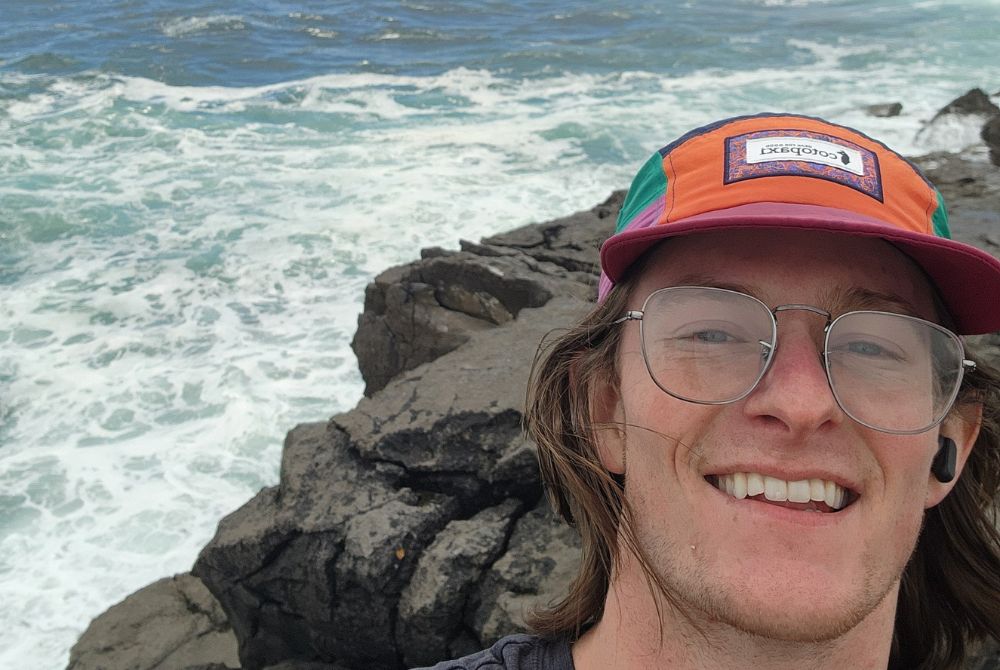
Reese came to Michigan State from Wyoming in 2022 and initially planned to study political science but changed course when his advisor recommended JMC.
His academic interests evolved quickly once he arrived in Case Hall. Beyond CCP, Reese added a Science, Technology, Environment & Public Policy (STEPPS) minor and pursued an interdisciplinary studies major through the College of Social Science focused on climate and adaptation. The combination reflected his growing interest in how environmental challenges intersect with policy and culture.
“Leaving Wyoming and being in Michigan, there’s this comparative environment — comparative ecologies, comparative social spheres and political spheres that have to do with nature and environmental governance and natural resources,” Reese explained. “All the things that I grew up a part of but didn’t realize I was academically interested in until I saw that comparison.”
For his JMC field experience requirement, Reese chose an internship in Dublin. He’d been drawn to Ireland for years — family connections, cultural interest, the landscape — and things fell into place to pursue an internship abroad. “I was looking through the options and when I saw that it aligned with my interests and that the program was the whole summer and not just a few weeks, it seemed like a good adventure for me,” he said.
Working with Coastwatch
Reese’s internship with Coastwatch threw him into the environmental organization’s work immediately. His supervisor, marine biologist and Coastwatch co-founder Karin Dubsky, had been conducting coastal surveys and conservation work in Ireland for decades. The job kept Reese moving: one afternoon he’d be on an hour-long train ride to photograph algae on slipways, the next day he’d be carrying buckets of seaweed through Trinity College’s geology museum to measure and weigh specimens.
.jpg)
The most significant project centered on Sargassum muticum, an invasive seaweed species that has plagued Irish coasts since the 1970s. In summer, 2024, the species was particularly visible along Dublin’s south coast, overtaking native marine habitats and threatening local biodiversity.
Reese was tasked with creating an information pamphlet for public distribution. The research was extensive and the project went through more than 20 iterations as it balanced scientific accuracy with accessibility for audiences of all ages and backgrounds.
The result became central to three community and citizen science events which Coastwatch organized at Sandycove Bay in Dublin. Reese helped coordinate the events, created promotional materials and led groups of volunteers in removing the invasive seaweed from intertidal rock pools. The events drew families, members of the Sandycove Kayak Club, local lifeguards and divers.
At one event, Reese watched a local resident hold up a strand of Sargassum in front of young beachgoers, explaining exactly what Reese had taught earlier about where the seaweed came from and how it harmed local environments. “In this moment I saw in real time why citizen science is important,” Reese wrote in his field experience reflection paper. “I saw informal information sharing and genuine community building.”
Observing governance at multiple levels
Beyond fieldwork, Reese’s summer included exposure to environmental governance at multiple levels. At the EPA Water Conference, he attended two days of presentations from politicians, academics and nonprofit organizers. He went to a degrowth conference at Trinity College’s business school, where speakers debated capitalism and climate justice.
He also sat in on local fishery board meetings and city council sessions, watching how policy intersects with community knowledge at the ground level. “These folks know each other, have long working relationships, are bringing different knowledge into the space where policy is formed,” he said. “The knowledge doesn’t become policy without that collaboration and communication.”
The work revealed gaps in how international and national frameworks translate to local conservation needs. Why had existing policies failed to prevent Sargassum muticum’s spread? How do EU directives filter down to Irish coasts? Who carries the burden when formal governance falls short?
These questions became the foundation for a research paper Reese wrote the following semester in MC 401. The paper examined policy failures across global, international, EU and Irish frameworks, identifying gaps in accountability and coordination that left NGOs like Coastwatch managing problems that formal governance structures had failed to address.
“Colin’s paper is an exemplar of place-based, community-engaged research that was only possible because of his experience traveling to study in Ireland,” wrote JMC Prof. Mark Axelrod in support of Reese’s Academic Achievement Abroad nomination. “Colin approached the topic with great respect and humility for local organizations and community members, listening to their ideas in order to develop his participatory research plans. As he told me, it was essential to understand ‘their concerns about their home’ in order to identify what he should explore.”
Reese has carried the Ireland experience forward. The following summer, Reese participated in the Demmer Scholars program in Washington, D.C., where he worked on natural resource policy with the National Association of State Foresters. There he approached environmental governance from a different angle but with the same interest in how policy frameworks shape conservation work on the ground. Back at MSU, he brought what he learned in Ireland to his leadership role with the Sierra Club, where he’d been involved since his first year organizing invasive species removal events and partnering with the Michigan DNR. The community-based approach he witnessed in Dublin made more things seem possible closer to home.
Several JMC faculty members shaped Reese’s path through his time at the college and supported his work in Ireland. Prof. Axelrod provided feedback on his research paper and has continued mentoring Reese through an independent study on natural resources and environmental governance.
Prof. Andaluna Borcila mentored his MC 401 research paper and pushed his analytical writing in new directions. Prof. Amanda Flaim encouraged him to explore questions about meaning-making, tradition and storytelling in his senior seminar, helping him understand how culture shapes environmental practices.
“I fell in love with understanding how different governments interact, both with each other and with citizens or communities,” Reese said about his time at JMC.
Looking ahead
This summer, Reese plans travel to Sri Lanka and India with JMC Prof. Sejuti Das Gupta for the Global Development in South Asia education abroad program. After graduating, he plans to pursue graduate study in environmental governance and policy communication and is currently exploring options in the U.S. and abroad.
The Ireland experience clarified what Reese wants from his career: work that bridges community knowledge with national and international policy frameworks, research grounded in lived experience rather than abstraction, opportunities to combine academic work with being outdoors.
“It made me more interested in making participatory environmental governance and participatory natural resource governance a workable, real and realistic solution to a lot of these environmental issues that manifest at local levels,” Reese said. “I think it made me believe more that my approach of being a social scientist and believing in community building in terms of problems that are often seen as problems of the natural sciences or the climate sciences seem more valuable and possible.”