The questions that shaped Professor Emeritus M. Richard Zinman’s 46-year teaching career at James Madison College — Who am I? How should I live? What is the best way of life for an individual? What is the best form of government? — now guide a new fellowship program established in his honor.
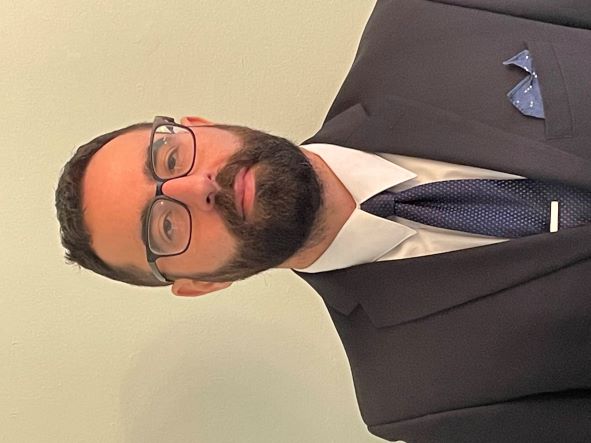
Dr. Ariel Helfer, associate professor of political science at Wayne State University, has been selected as the inaugural M. Richard Zinman Scholar in Residence, bringing his expertise in classical political philosophy to JMC for the 2025-26 academic year. The program is designed to honor Zinman’s transformative approach to undergraduate education and his commitment to studying the greatest texts produced by the greatest minds.
“We thought for this first Zinman scholar in residence we would want to have somebody who has made the ancient philosophers the centerpiece of his own education,” explained Prof. Tobin Craig, who served on the faculty committee that reviewed applications. “Dr. Helfer stood out to us as a young scholar who has done exciting work on Plato’s political philosophy.”
Zinman, who joined JMC in 1969 and retired in 2014, helped complete the founding of the college and co-founded its Political Theory and Constitutional Democracy program. His approach to education centered on bringing alive the highest and most difficult human questions through close study of classic texts ranging from Plato and Aristotle to Machiavelli and Nietzsche.
The endowment that supports the residency program, partially funded by Zinman’s former students and friends, reflects his core educational philosophy: that undergraduate liberal education should cultivate free, self-governing minds through inquiry into enduring human questions, guided by the greatest books and conducted with rigorous, skeptical reading.
“Professor Zinman epitomizes someone who was himself educated by the great classic texts in political philosophy but also was able to bring them to bear on contemporary issues in a meaningful and personally transformative way,” Craig noted. The selection of Helfer reflects careful attention to teaching ability alongside scholarly credentials. In his application materials, he indicated that he was himself inspired by professors in Zinman’s legacy as an undergraduate educator.
Helfer’s recent work includes a new translation and interpretation of Plato’s letters and a study of Plato’s portrait of Alcibiades. For his residency project, he will undertake a sustained study and series of translations focused on Isocrates, a classical philosopher who remains much less familiar than canonical figures like Plato, Aristotle and Xenophon.
“This struck us as a really exciting possibility for both students and faculty to learn about a thinker that is much less familiar than the other canonical thinkers of classical antiquity,” Craig said. The project offers a unique opportunity to engage with important classical texts that are typically inaccessible to undergraduate students, providing fresh perspectives on ancient wisdom that have been largely overlooked in contemporary education.
The project aligns with Zinman’s belief in ranging widely in selecting texts for study. Isocrates, an Athenian orator and educator, offers perspectives on rhetoric, education and political life that complement but differ significantly from those of his more famous contemporaries. His emphasis on practical wisdom and the art of persuasion provides valuable insights for understanding both ancient Athens and contemporary democratic discourse.
Dr. Helfer’s residency will combine public lectures with seminars, creating multiple opportunities for student engagement. Participants will receive draft versions of his new translations of Isocrates’ writings, allowing them to engage directly with texts.
“One of the exciting things about this project is that it’s going to culminate in new translations of certain of the most important writings of Isocrates, which our students will have seminar discussions with Dr. Helfer about,” Craig explained. The public lectures will explore why these ancient texts remain relevant for contemporary readers, while the seminars will provide settings for students to grapple with the texts alongside an accomplished scholar.
This format mirrors Professor Zinman’s own teaching approach, which combined careful textual analysis with broader questions about how classical wisdom applies to modern challenges. The combination of translation work, seminar discussion and public presentation creates what Craig describes as “a sustained experience in the classroom with an experienced professor” who embodies the college’s educational mission.
Dr. Helfer’s first scholar in residence lecture will be held in Case Hall on Feb. 18, 2026 (details forthcoming). Support the M. Richard Zinman Professorship in Classical Political Philosophy online.