Jordan Cash’s summer classroom stretched from Grand Rapids to Chicago to West Lafayette to Charlottesville.

Over the last few months, the James Madison College professor led civic education programming for Michigan teachers in Grand Rapids, Chicago-area teachers studying the Civil War era, Indiana teachers at Purdue University, high school students on MSU’s campus, and graduate students and early-career scholars designing their first college courses.
The audiences varied, but the work shared a common method: returning to the original sources and arguments that shaped American political institutions.
“You don’t get as much when you’re not reading the original sources,” explained Cash, whose research and teaching focus on American political thought and constitutionalism. “Being able to go back to the text, to see what’s really being said, to wrestle with the arguments as they were presented at the time by the people making them, is so beneficial.”
Cash did not read The Federalist Papers until he was partway through college, a gap he now regrets, given how essential they are to understanding how the federal government works and why it is built as it is. The same is true of other founding texts. A textbook can report that Britain passed laws, colonists resisted and independence followed, but that summary flattens what was a live argument over rights, power and the purposes of government.
“There are debates and there are reasons behind all of these things,” he said. “And when we don’t understand those reasons, then we don't really understand what’s going on here.”
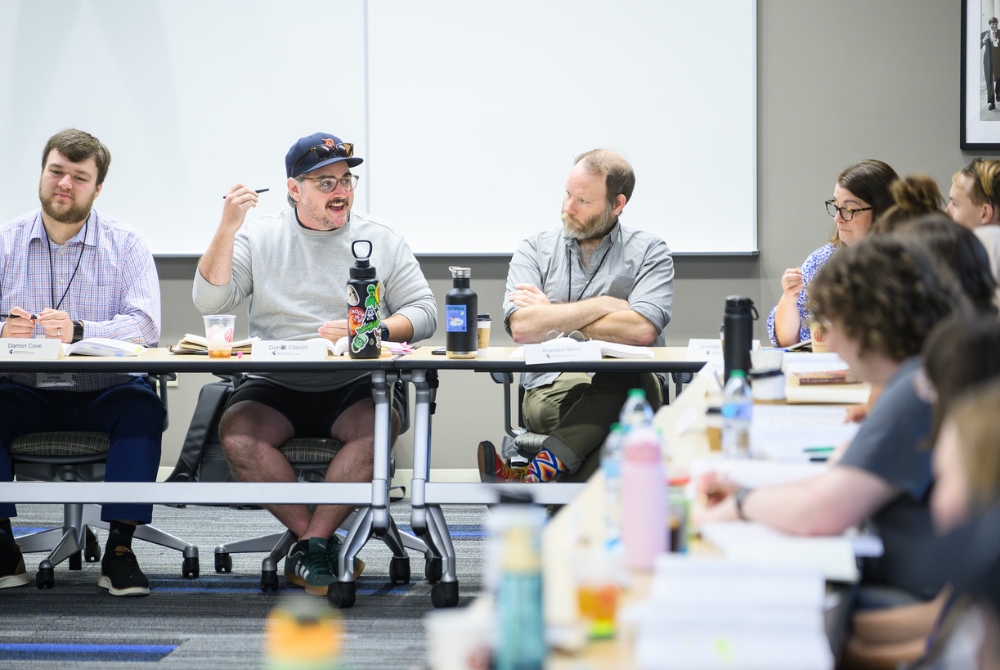
This philosophy is at the heart of the James Madison College Academy for Civic Education (ACE), a new initiative supported by a $1.3 million U.S. Department of Education grant that brings JMC’s approach to civic education to Michigan high school students and teachers. Its summer seminars are built on primary sources: the Constitution, The Federalist Papers, landmark Supreme Court decisions and the speeches that have shaped American democracy.
In late June, Cash and JMC Prof. Brianne Wolf led the first cohort of the educator program, which pairs close reading of foundational texts with classroom-ready strategies for teaching them. The program brought 28 Michigan teachers to Grand Rapids, the first stage in ACE’s effort to reach educators across the state. The teacher programs are an extension of similar initiatives Cash and Wolf have hosted in Case Hall in previous summer summers.

Teaching teachers calls for a different emphasis than teaching undergraduates, Cash explained. Students in JMC’s Political Theory & Constitutional Democracy program often arrive well versed in theory and need to see how ideas move policy and politics. The teachers, most of whom teach American history, know the events in detail but want a firmer grip on the ideas beneath them: why the Declaration of Independence argues as it does, or what makes Federalist 10 matter.
“The passion is there, a lot of the knowledge is there, but the foundations could be strengthened,” Cash said.
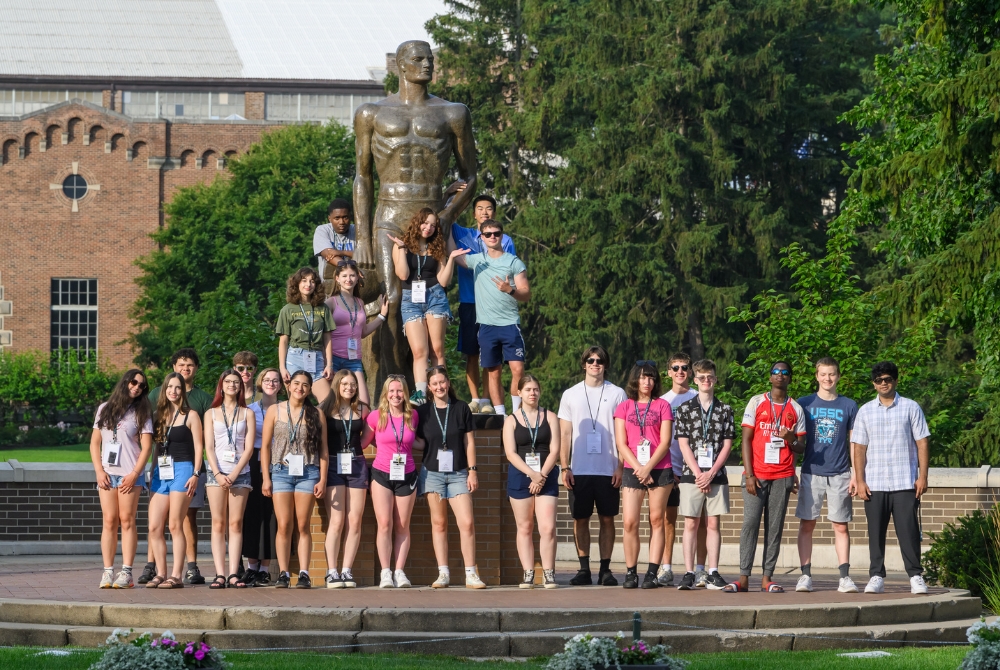
After the Fourth of July, Cash traveled to Chicago for a teacher program run with the Jack Miller Center and the Big Shoulders Fund, where he led sessions on the Civil War era and the speeches of Abraham Lincoln. He then headed to Purdue to discuss executive power and the presidency in that university’s first summer teacher program. Back on MSU’s campus, he was part of the team behind ACE’s high school student program, a two-week residential seminar giving rising seniors from across Michigan a college-level, discussion-based study of American democracy and a taste of JMC life.
Cash also returned to where his own path in this type of work began. Earlier in his career, he taught his first teacher seminars as a postdoctoral fellow at the University of Virginia’s Program on Constitutionalism and Democracy. In July, he came back as a faculty member for the Jack Miller Center’s annual Summer Institute, leading a session on course design for early-career scholars. Most came from history or political theory backgrounds, he said, and wanted help grounding new courses in American constitutionalism.
The trip closed a circle. Cash was a summer fellow at the same institute just before his UVA postdoc, and being back in Charlottesville allowed him to reconnect with mentors he had not seen in years, among them James W. Ceaser, who ran the program Cash worked in and whom he calls one of the greatest living scholars of American political thought.
He wrote through the travel, in what he called “a very Jeffersonian summer.” Cash is editing two volumes of Thomas Jefferson’s political writings for Cambridge University Press, set for publication in March 2027, in a series that already includes Hamilton, Washington and Lincoln. He is also preparing a conference paper on Jefferson that will feed his next book, a study of Congress. That book extends an idea he calls “constitutional logic” drawn from his first book on the presidency to other institutions. The teaching feeds the research too: a session Wolf once taught on political economy at the founding sent Cash back to two lesser-known Federalist essays he has since folded into his JMC syllabi.
The work continues this fall, closer to home. On Sept. 19, Cash and Wolf will host a one-day JMC-ACE colloquium for Michigan teachers that will focus on the Declaration of Independence and the Constitution, held just after Constitution Day and timed to the nation’s 250th anniversary. Cash sees it as the first of a series that could take up American foreign policy, political economy and other themes in future semesters.
Michigan educators interested in participating in the Sept. 19 colloquium can learn more on JMC's website and register to attend via Google Forms.