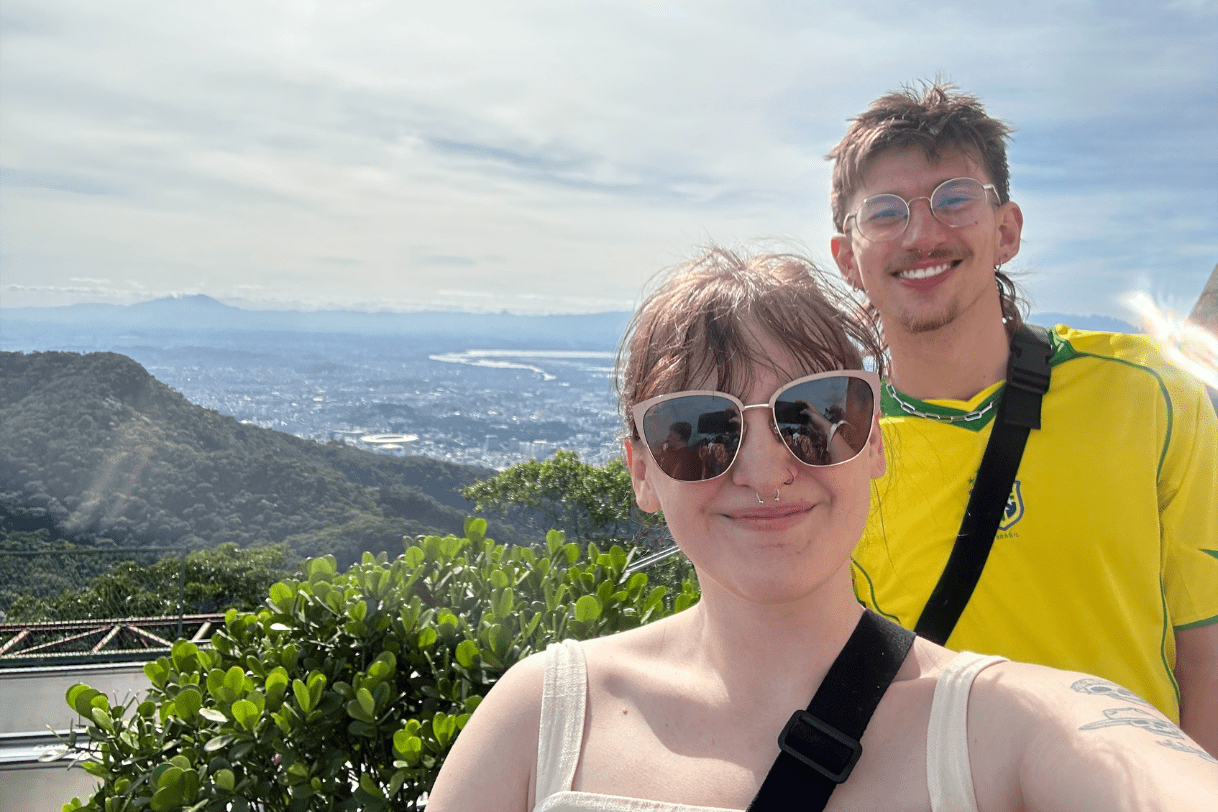
Four students — two from James Madison College, two from the Federal University of Bahia — spent part of last summer in Salvador, Brazil, writing a comparative history of immigration policy in their two countries. The paper they produced, “The Reciprocal Nature of Racism and Immigration Policy,” has since been translated into Portuguese and accepted at the Brazilian Studies Association Conference, which meets this summer.
This type of collaboration is at the heart of the Politics, Culture & Society in Brazil program. A partnership between MSU and the Federal University of Bahia (UFBA), the six-week education abroad program pairs students from both institutions in classes on Brazilian politics, economics, society and race. Addy Russel (PTCD & SRP) and Max Rehn (CCP & Global History) were among 10 JMC students who traveled to Brazil in last summer’s cohort.
Salvador, the capital of Bahia, is a center of Afro-Brazilian culture and a focus of the program’s study of race and identity in Brazil. The program builds on that setting with classroom instruction at UFBA, site visits across Salvador and time for students to travel the region alongside Brazilian student participants.
Those pairings carry into the coursework, which is organized into weekly modules. Midway through the program, students work in groups and choose one as the basis for a collaborative final paper. Russel and Rehn worked with UFBA students Gabriel Rodrigues and Sophia Höhlemwerger to explore the module on race.
The UFBA students had backgrounds in law, geography, public administration and other fields, which Russel said broadened the conversation: “You get a lot of different perspectives within JMC, but coming from different majors, it felt kind of refreshing.”
The group split the paper four ways. Rehn wrote the U.S. historical section on the 1924 Johnson-Reed Act, which restricted immigration to the U.S. through a national origins quota. Russel took the U.S. contemporary section to discuss immigration policy after 9/11 and during the Trump administration. Höhlemwerger and Rodrigues covered the Brazilian sections, tracing the early 20th-century policy of encouraging European immigration, the pause on immigration under Getúlio Vargas in the 1930s and the later framing of Brazilian national identity as a racial democracy.
They began drafting in Salvador, presented an outline on the program’s final day and finished the paper over Zoom in the month after returning home. UFBA Prof. Cloves Oliveira saw conference potential in the paper and gave them additional time to revise so he could submit it. Months passed before they learned it had been accepted at the Brazilian Studies Association Conference, which supports and promotes Brazilian studies in all fields.
Beyond the coursework, the program left its mark in other ways. Russel started learning Portuguese after returning home so she could keep up with the UFBA friends she still talks with every week. “Meeting the other students from UFBA was probably the best part for me,” she said. Both Russel and Rehn traveled to Rio de Janeiro with friends before the program began, and Rehn spent a weekend in a national park in central Bahia during the six weeks in Salvador.
Both students said the experience shifted how they think about international travel. Neither had spent more than a few weeks out of U.S. before the trip. “Now that I know what six weeks is like, I feel like I could spend maybe a few months in another country,” said Rehn. “Before, I don’t think I had the mindset”
Both hope to return to Brazil. Russel is in the process of seeking funding in the hopes of attending the BRASA conference this summer, where the paper will be presented. Rehn, who will graduate from JMC in May, would like to visit on his own one day. “We barely scratched the surface,” he said.
Learn more about the Politics, Culture & Society in Brazil via MSU Education Abroad.