When Livingston County’s Planning Department offered Abigail Carrigan an internship, she didn’t hesitate. She had never taken a planning course, but she was confident she could tackle the challenge of developing the agriculture component of their upcoming master plan. Carrigan was a sophomore at James Madison College with a growing focus on agricultural sustainability and rural communities, a set of minors that mapped neatly onto the work and a willingness to figure out the rest.
“I went home and I did my homework and I thought, OK, no, I can actually figure this out,” Carrigan said.
What started as a single chapter became a standalone plan. Working part-time from May through December 2024, Carrigan produced the “Livingston County, Michigan: 2025 Sustainable Agriculture, Food Systems, & Rural Environments Plan.” The comprehensive document was adopted by the Livingston County Planning Commission and has since won awards at both the state and national level.
Finding a Focus
Carrigan (Social Relations & Policy ’25) came to JMC as a first-year student looking for a smaller, more rigorous community within Michigan State. She arrived thinking she’d study International Relations but decided on SRP during her first semester, drawn to its domestic focus and the way the major encouraged students to examine issues within broader systems.
“I’ve always thought that rural communities are often easily overlooked,” Carrigan said, who grew up in Livingston County. “What led me into SRP was being able to address some of these gaps, but within a broader systemic approach.”
Her interest in agriculture and rurality, specifically, traces back to an unlikely source. Carrigan is a devoted fan of 1950s music, and a trip to see the Iowa ballroom where Buddy Holly played his last concert introduced her to the state’s rural landscape and farming communities. What started as a love for open space became a more serious focus once she started learning about the environmental pressures behind it.
From that point, nearly everything she did academically oriented around agricultural sustainability and rural communities. She paired her SRP major with three minors: sustainable agriculture and food systems, human, environment and economic geography, and environments and health. Courses like MC 111 (Identity & Community) with Prof. Ben Marley and MC 338 (Environmental Justice) with Prof. Daniel Ahlquist gave her room to explore these interests in depth.
“Within James Madison, you can really tailor your courses around your niche interests because you have so much freedom to do research and explore,” she said.
Livingston County Internship
In 2024, Carrigan started reaching out to local governments across the region looking for internship opportunities. During her interview with the Livingston County Department of Planning, the staff described a challenge they were facing: the county was seeing growing development pressures, and residents were pushing for preservation of agricultural land and rural character.
They asked if she could draft the agriculture component of their upcoming master plan.
Between the interview and her first day, Carrigan got to work. She read zoning ordinances cover to cover, studied master plans from other communities, and taught herself the differences between county, township and city planning structures. By the time she started, she had a framework ready.
The project grew well beyond its original scope. Carrigan’s finished plan is organized around seven areas of agriculture and food system planning (view via PDF). For each area, she provided data on how the issue affects Michigan and Livingston County, identified planning strategies available to local governments, and compiled a guide to existing state and federal programs. She also conducted community engagement throughout the process.
The plan was adopted by the Livingston County Planning Commission in December 2024 and became an official county plan in 2025. Its content also served as a major contribution to the 2026 Livingston County Master Plan.
Recognition & Looking Ahead
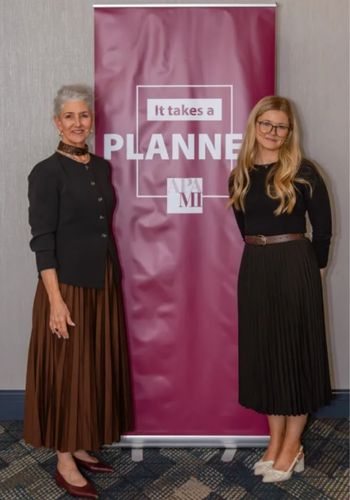
In October 2025, the Michigan Association of Planning (MAP) awarded Carrigan’s plan the Outstanding Undergraduate Student Project Award as part of its 2025 Planning Excellence Awards. A jury of MAP members reviewed the work and called it “exceptional.”
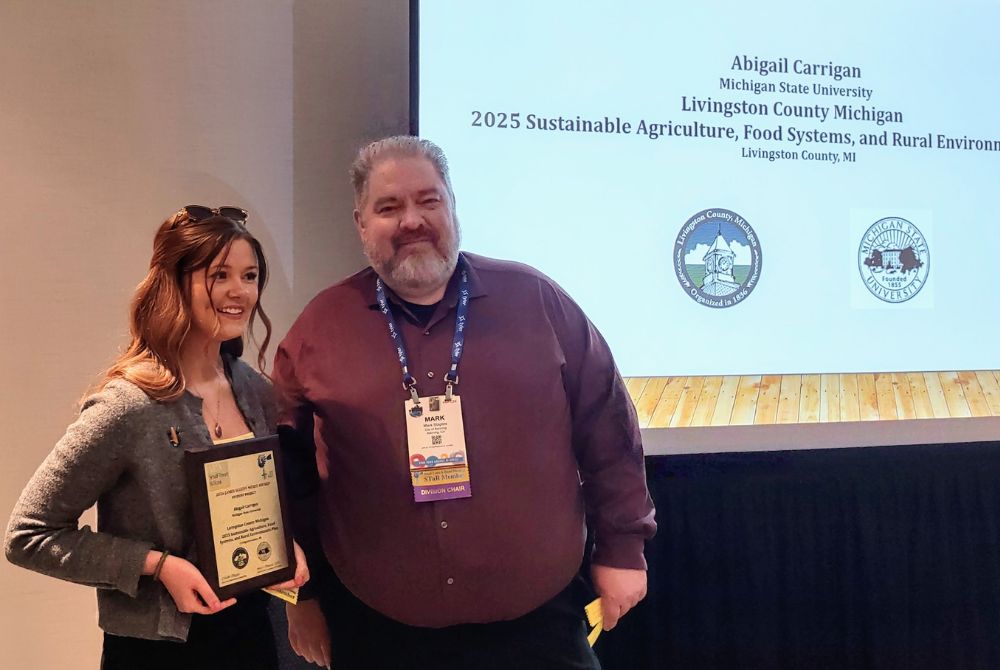
A national honor came next. The American Planning Association’s Small Town and Rural Planning Division selected Carrigan for the 2026 James A. Segedy Merit Award, which recognizes outstanding student projects addressing planning issues in small towns and rural areas.
Beyond her Livingston County work, Carrigan is also a part of the circular economy research team at MSU’s Center for Community and Economic Development, where she has conducted outreach to recycling facilities across Michigan and developed a toolkit for identifying reuse markets for recycled materials in the state.
She graduated from JMC in three and a half years in December 2025 and earned the Outstanding SRP Graduate Award this spring. In the fall she will begin a master’s program in urban and regional planning at the University of Michigan, concentrating in land use planning. She plans to continue working at Livingston County while pursuing her degree and hopes to research renewable energy siting in rural Michigan for her thesis.
Asked about her long-term goals, Carrigan said she wants to stay close to the community-level work that drew her into planning in the first place.
“I’d like to have a concrete accomplishment of like, OK, this is how much land we’ve preserved,” she said. “And I’d really like to engage the community and promote strengthening the connections people have to the land around them.”