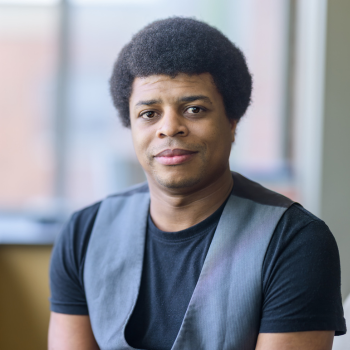
Orlando Hawkins joined James Madison College in Fall 2025 as an Assistant Professor of Political Theory & Constitutional Democracy. His areas of specialization include (but are not limited to) Black Existentialism, Black Feminist Philosophy, Critical Philosophy of Race, Black Marxism, Black Radical Philosophy, Ethics, Friedrich Nietzsche, Frantz Fanon, W.E.B. Du Bois and Social/Political Philosophy.
Tell us about your academic background.
I started off at a community college. I’m from California and I went to a community college called Mt. San Antonio College (Mt. SAC) for two years. Then I ended up at a private, liberal arts school called the University of La Verne. It’s very small. You can walk the entire campus within 15-minutes and be done with the campus visit at La Verne, at least when I attended that school.
I took time off in between each of my degree programs and after La Verne, I ended up at The New School for Social Research (NSSR) in New York City for my master’s. I then went to the University of Oregon and finished my PhD in philosophy after six years in June (2025). Throughout all my degrees, except for Mt. SAC, I was studying philosophy.
What drew you to philosophy?
It was interesting because I would say I was generally a good student, but philosophy was the one class I kept getting A’s in consistently with the least amount of effort. I think at some point, it just hit me that maybe this is what I should do.
I would say, every step of the way, I never really knew what the outcome would be or how much I’d accomplish. I would take the approach of just setting the goal to complete my degree and then see what happens.
How did you end up finding your area of specialization?
In philosophy, there’s an area of study called “critical philosophy of race” — that’s the broad category. I specialize in Black politics and Black existentialism. As an undergrad, I was not familiar with this type of philosophy, so I did more traditional philosophical work, meaning the study of European philosophy or philosophers. When I got into my master’s program — I think the first Trump’s presidency might have something to do with it — there was a lot of discourse in the philosophy department and at the school more generally about race and politics. I had not been familiar with that area of philosophical study as an undergrad, so I thought it was something that I should explore as a grad student. So ultimately, I wasn’t really guided into it. Mostly it was a choice where I felt like I could make some type of contribution to the world by helping people understand these problems, from this racial standpoint.
What was your dissertation about?
In my dissertation I focused a lot on the problem of nihilism and anti-Blackness. I tend to think of anti-Black racism as a mechanism for trying to get Black people to think their lives or existence lack meaning. That’s essentially what the scope of the dissertation was about. I also explored how anti-Black racism has been challenged and how Black activism has found ways to produce a meaningful existence for Black people. This history of resistance, meaning, and activism is known as the Black Radical Tradition.
Which scholars have been most influential in your work?
I’ll try to keep it brief, but the main ones are W.E.B. Du Bois, Frantz Fanon, Cedric Robinson, Sylvia Wynter, and all the Black feminists that I’ve studied — Angela Davis, bell hooks, Patricia Hill Collins, among many others.
Does a lot of your work find connections between the contemporary and the historical?
Yes. For example, my job talk at JMC was mostly on the issue of pessimism and nihilism, which is part of my Black existentialist work. I wanted to show how anti-Black racism impacts Black people’s lives. I used research I found about suicides amongst Black youths and how that’s been increasing since the 1990s, just as one piece of evidence of the impacts of racism.
I tried to make a connection between Black youth suicides today, and how some people in slave narratives (like Frederick Douglass) would talk about suicide. So, I was comparing contemporary Black youth suicides with slave narratives, including Harriet Jacobs, Mary Prince, and Olaudah Equiano. Each narrative talked about a moment where they had thought about death or suicide because they didn’t want to be a slave for life.
Read Hawkins’ publication “Afropessimism and the Specter of Black Nihilism” in Philosophy and Social Criticism.
How do you see your scholarship evolving at JMC?
That’s a good question. A lot of my background involves reading and researching, so something I’m really getting interested in is archival work. That might be the next step in my research, especially with respect to slave narratives. I’ve been drawn to them a lot more within the past year or so (I’m not quite sure why), so I think that would be one avenue that I would want to consider using research resources for.
What courses are you teaching this semester?
This semester I’m teaching a senior seminar on “W.E.B. Du Bois and Democracy” and then a class called “Radical Challenges to Liberal Democracy”, which is a class on liberalism and liberal theory and how people challenge that. So, I’m integrating my background into that class where I’m bringing in a lot of Black political theory.
How do you approach teaching?
In terms of teaching, I’m usually guided by the particular reading. What I’ve learned in my teaching experience is that each reading will require a different approach. Even the same author like Du Bois — he wrote so much, but all his work is different, stylistically speaking. I include many different styles within my teaching, but it’s usually a mix of lecturing and class discussion. I tend to also have group presentations in my courses because I believe in students learning from each other as much as me teaching them and also providing them with different voices than my own.